






Strength testing of rail vehicles
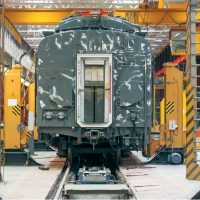
We have a nationally unique facility for static strength testing of rail vehicle bodies.
We also offer a facility for static and fatigue testing of steel structures such as bogie frames, bogie beams, brake triangles, and structural components (couplings, springs, rubber-metal components, dampers, etc.). In addition, our laboratory has a facility for fatigue testing of rail vehicle axles and wheels.
ACCREDITED TESTING
Strength testing of rail vehicles – our offer:
The test station mainly carries out static strength tests on rail vehicle body structures according to the:
- PN-EN 12663-1+A1:2014
- PN-EN 12663-2:2010
- PN-EN 283:1999
- UIC-566, edition 3:1994
- UIC-571-1, edition5:2004
- UIC-571-2, edition 6:2001
- UIC-571-3, edition 6:2004
- UIC-571-4, edition 6:2014
- UIC-577, edition 5:2012
- UIC-597, edition 1:1995
- ERRI B12/Rp 17, edition 9:2012
- TSI/Decision 2011/291/EU
- Commission Regulation (EU) No 1302/2014
- Commission Regulation (EU) 2015/92
The test station mainly carries out static and fatigue tests on, among other things, bogie frames and brake triangles according to the:
- EN 13749:2021 pt 6 appendix A-G
- UIC 510-3, edition 1:1994
- UIC-515-4, edition 1:1993
- UIC-615-4, edition 2:2003
- UIC-833, edition 5:2015
- ERRI B12/RP 17, edition 9:2012
- Commission Decision 2011/291
- Commission Regulations (EU) No 1302/2014
- Commission Regulation (EU) No 321/2013/EC
- Commission Regulation (EU) 2015/924
On the test station, fatigue tests of axles and wheels of rail vehicle wheelsets are carried out according to standards:
- EN 13979-1+A2:2011 para. 7.3 with appendix D
- PN-EN 13262+A2:2011 annex B
- EN 13103:2013+A2
- EN 13104:2013+A2
- PN-EN 13103-1:2018-05
Our reports are recognized in all countries that are signatories to the ILAC MRA multilateral mutual recognition agreement.
Why does accreditation matter?
Choosing an accredited laboratory, such as the Łukasiewicz Research Network – Poznań Institute of Technology, ensures that tests are conducted in accordance with the highest standards and applicable norms, such as PN-EN, UIC cards, and Technical Specifications for Interoperability (TSI). Accreditation confirms the competence of the staff, the quality of the testing equipment, and the reliability of the results obtained, which are essential in the certification and approval processes for vehicles.
What is subject to strength testing in rail vehicles?
The scope of strength testing is broad and covers critical structural elements. At Łukasiewicz – PIT, we focus on accredited testing of:
- rail vehicle body construction: mainly static tests are carried out to verify the resistance of the entire shell of a carriage or locomotive to assumed load scenarios (in accordance with, among others, PN-EN 12663),
- bogie frames, their assemblies and components: both static and fatigue tests are performed in this area. These tests (carried out, for example, in accordance with PN-EN 13749) are designed to confirm the strength of bogie frames, which are crucial for safety and driving comfort. Other bogie components, such as brake triangles, are also tested.
- axles of wheel sets and wheels: due to their critical role in vehicle handling, axles and wheels are subjected to rigorous fatigue testing (e.g. according to PN-EN 13979-1, PN-EN 13262 standards), which simulate multiple load cycles occurring during operation.
What are the benefits of accredited strength testing?
Increased security level
Structural optimization
Extending the service life of rolling stock
Possibility of placing the vehicle on the market
Building trust among partners
FAQ
I would like to conduct a strength test on the carriage body in accordance with UIC-566. Is this possible?
Yes, we perform accredited static strength tests on rail vehicle body structures, including in accordance with the guidelines of UIC-566.
Do you perform fatigue testing of bogie frames in accordance with PN-EN 13749?
Yes, we are accredited for static and fatigue testing of bogie frames and their assemblies and components, including in accordance with PN-EN 13749, section 6, together with appendices A-G.
I need to test the fatigue strength of railway axles. What standards does your accreditation cover?
In the field of fatigue testing of axles and wheels of wheel sets, we work in accordance with, among others, the following standards: PN-EN 13979-1+A2:2011 (section 7.3 of Appendix D), PN-EN 13262+A2:2011 (Appendix B), EN 13103, EN 13104 and PN-EN 13103-1.
Where can I find a complete list of standards according to which Łukasiewicz – PIT performs accredited strength tests on rail vehicles?
The detailed and current scope of our accreditation, including a full list of standards, is always available from our Customer Service Department. We will be happy to provide it to you!
What exactly is the difference between static testing and fatigue testing of rail vehicles?
Static tests involve applying specific, constant loads to a structure (e.g. bodywork, bogie frame) in order to verify its strength and rigidity under these loads, in accordance with the requirements of standards (e.g. PN-EN 12663-1 for bodywork). We check whether the structure does not deform excessively and is not damaged. Fatigue tests (e.g. on bogie frames according to PN-EN 13749, or axles and wheels according to PN-EN 13262) simulate the repeated, cyclical loads to which a vehicle is subjected during many years of operation. Their purpose is to assess fatigue strength and detect potential crack initiation points.
Does your laboratory perform strength tests only on complete vehicles or also on individual components?
Our accredited scope covers testing of both entire structures, such as rail vehicle bodies, and key components. We specialise in static and fatigue testing of bogie frames (both complete and their components, e.g. beams, brackets, brake triangles) and fatigue testing of axles and wheelsets.
What information or documentation is typically required from the customer to begin the accredited strength testing process?
In order to prepare and conduct tests, we primarily require technical documentation of the tested object (construction drawings, 3D models, material specifications), information about the anticipated operating conditions, and a clear definition of the scope of tests and standards according to which they are to be conducted. The detailed scope of necessary data is determined individually at the stage of preparing the offer.
Are the results of strength tests conducted at Łukasiewicz – PIT recognised abroad, e.g. in other European Union countries?
Yes, the accreditation of our laboratory by the Polish Centre for Accreditation (PCA), which is a signatory to multilateral agreements within the European co-operation for Accreditation (EA MLA), ensures the recognition of test results in countries that are parties to these agreements, including most European Union countries. Tests conducted in accordance with EN standards or UIC cards are widely accepted in the railway industry.
Is it possible to conduct strength tests according to specific customer requirements if they are not explicitly included in popular standards but are within the technical capabilities of your testing station and accredited testing methods?
Our goal is to support our clients in comprehensive strength assessment. If a customer’s specific testing requirements can be met using methods covered by our scope of accreditation and are within the technical capabilities of our unique testing facility, we are open to discussing and implementing such non-standard test scenarios. Each such request is analysed on a case-by-case basis.
What does it mean in practice that the strength test of the bogie frame complies with the PN-EN 13749 standard?
Compliance with PN-EN 13749 ‘Railway applications – Wheelsets and bogies (…)’ means that tests are carried out according to a procedure strictly defined in this standard. This standard defines, among other things, the loads to be applied (both static and fatigue), the method of securing the test object, the locations and methods of measuring deformations, and the criteria for evaluating the results. Compliance with this standard ensures the comparability and reliability of bogie frame strength tests throughout Europe.
Our expert:
Bartosz Grzelka
Phone: +48 605 994 005
Łukasiewicz research Network – Poznań Institute of Technology, Centre for Laboratory Testing (Laboratory for Material Testing), 181 Warszawska Street, 61-055 Poznań, Poland

See also non-accredited strength testing of rail vehicles