






How did the whole world end up in the Persian Gulf?
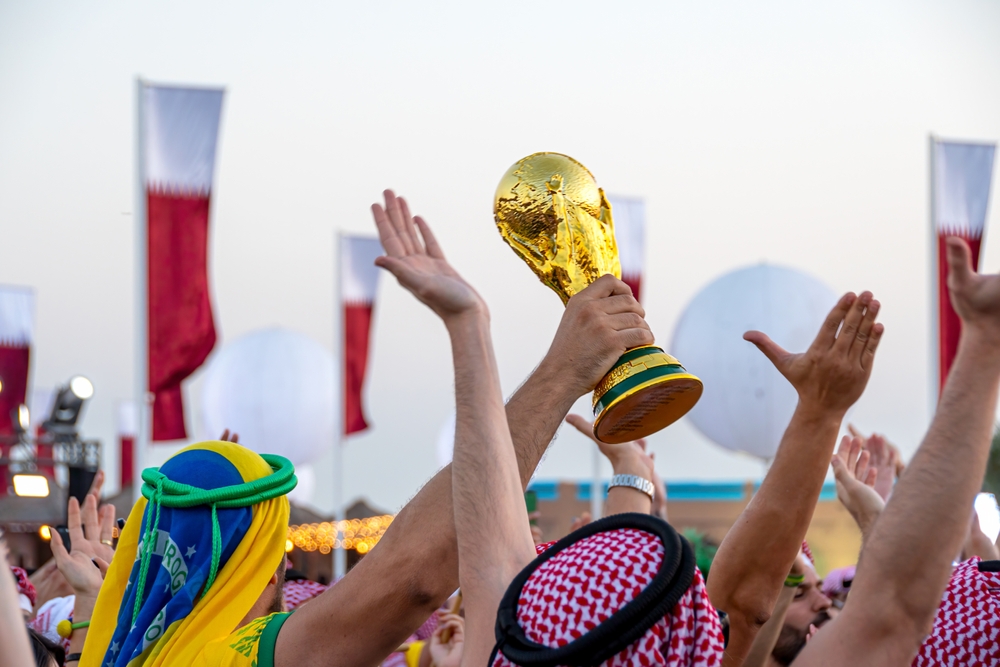
The final of the World Cup in Qatar is just around the corner. After an interesting and extremely even group stage, the tournament has entered the decisive phase. We already know that Argentina and France will compete in the World Cup final, and our export referee Szymon Marciniak will be the referee for this match. In the consolation match, we will see Croatia and Morocco. Despite the controversy surrounding the organisation of the championship, and even calls for a boycott of the event by some athletes and fans, the event is very popular. While the stadiums look impressive on television screens, it is worth taking a look at the logistics of this event.
According to Nielsen research, a total of 14.3 million Poles watched the broadcast of the Poland-Argentina match, with a record 1.9 million watching on the mobile app and website. This is the sixth highest viewing figure in the history of the most popular sporting events in our country. The round of 16 match against France was two places lower in this ranking, in 8th place. Even blockbuster matches without the participation of the white and red team attracted an audience of several million viewers.
Amidst all the World Cup excitement, relatively little attention was paid to logistical issues. Qatar, a country with an area comparable to the Świętokrzyskie Province, had to prepare for the influx of several hundred thousand fans from around the globe, organising hotel accommodation, restaurants, transport and fan zones for them.
Aircraft logistics
Qatar is located on the Arabian Peninsula on the Persian Gulf. It shares a land border only with Saudi Arabia. This small desert country is home to nearly 3 million people, most of whom are immigrants. Native Qataris make up just over 10 per cent of the population. Interestingly, the country’s wealth comes not from oil, but from natural gas. In 1939, deposits of blue fuel were discovered there by the British, for whom Qatar was one of their colonies. Previously, the inhabitants of the peninsula had been engaged in pearl fishing.
The organisers of the Qatar championships faced a considerable logistical challenge: how to accommodate an additional million people? How to efficiently organise their air transport?
Hamad Airport, located near the capital of Doha, became a hub for hundreds of thousands of passengers. The Flightradar24 map for tracking flights on the eve of the championship looked like a crowded street in Mumbai or Istanbul, but according to eyewitness accounts, there were no complications or difficulties.
As Marta Cudziło, an expert at the Łukasiewicz-Poznań Institute of Technology, points out, when planning air transport, it is important to take into account the fact that the aircraft will not pick up the goods directly from the point of dispatch and deliver them directly to the point of collection. It is therefore important to properly plan all operations related to the delivery of goods to and from the airport. The organisers took care of all these details.
Of course, it is worth considering the high costs of air transport and the limited load capacity of aeroplanes. The teams had to limit themselves to only the most necessary equipment in order to avoid additional charges. Weather conditions did not play a major role in Qatari logistics. Throughout the World Cup, there were no sandstorms, as predicted by meteorologists, which could have disrupted logistics processes.
Hotel logistics
Sports logisticians encountered difficulties. Only limited amounts of equipment could be transported to Qatar. All additional services on site were associated with horrendous fees, as PZPN spokesman Jakub Kwiatkowski said in September in an interview with TVP Sport.
I think we will fly to Qatar one more time, in October. We will organise the trip ourselves to check everything one last time. Final touches. Some people from the PZPN will also fly out a few days before the team. These are mainly employees responsible for logistics […] FIFA provides basic equipment, and we have to rent the ‘extras’ on site. We are an experienced federation. We know what we want and what we need.
When organising the stay, it was therefore important to optimise costs in relation to the needs of the team. The richest national teams could afford modern training centres, while the others had to make do with what they had.
Only Germany decided to stay outside the Qatari capital and its surroundings. Our western neighbours chose a luxurious base in Ar-Ruwais in the north of the country, a city about 100 kilometres from Doha. There, they trained at a facility resembling a fort. The Al-Shamal SC stadium can accommodate 5,000 spectators. It is surrounded by walls on all sides, with towers in the corners.
The White and Reds qualified for the World Cup through the play-offs as one of the last teams. As a result, the Poles’ options were even more limited. Although logisticians were in contact with Qatari entities, the best options had already been reserved by competing teams.
Ultimately, the Poles chose the five-star Ezden Palace Hotel within the metropolis. The facility, which was opened in 2018, features Andalusian-style architecture. The hotel is modern, but it cannot be compared to the luxury venues in the West Bay district.
‘Luxurious’ barracks
Journalists sent to the World Cup visited fan villages to see for themselves the ‘famous’ containers and tents where representatives from all over the world found accommodation. According to their reports, the comfort and quality of the accommodation left much to be desired. A single night’s stay cost over a thousand zlotys. Guests could only count on basic amenities, such as a tea and coffee making set, two bottles of water per day, a refrigerator, bed linen and bathroom towels. At that time, prestigious hotels were only available to tourists with larger wallets, accredited media or the ‘FIFA family’.
Due to the fact that Qatar only borders Saudi Arabia by land, some fans chose to stay in the United Arab Emirates. From there, they flew to the matches, as the transfer from Dubai to Doha takes only an hour and 10 minutes. Krzysztof Stanowski from Kanał Sportowy was one of those who travelled this way.
Interestingly, during the group stage of the winter World Cup (20 November – 2 December), it was not possible to enter the country without a valid ticket for at least one World Cup match. This restriction did not apply to citizens of the country and people with work visas. Unfortunately, some Polish fans who wanted to fly to the round of 16 match against France were detained at the airport due to a problem with the Hayya app.
Smartphone logistics
All persons arriving in Qatar are required to install two applications on their smartphones: Hayya and Ehteraz, which are essentially no different from spyware. When downloading them, users must allow access to all data on their phones, even sensitive data, which makes it possible to surveil fans from around the world.
The first app, Hayya, is a kind of entry visa to Qatar, the only one granted between 1 November and 23 December. It is useful for tracking matches and viewing purchased tickets. It also allows free use of public transport, including the autonomous metro. At the same time, it requires the user to grant access to their location and personal data.
The second application, Ehteraz, was created to monitor Covid-19. The software can track your exact location using Bluetooth or Wi-Fi, and can also ‘read, change or delete’ all the content on your phone, which is not mentioned by Google Play or the App Store during installation. In this situation, ‘someone’ can edit messages or view photos on your private phone.
The German Data Protection Commissioner pointed to the enormous threat to privacy and recommended installing both applications on devices that we do not use on a daily basis. Similar recommendations were also issued by, among others, the Norwegian and French security agencies: ‘It is best to limit the use of social media or online banking while there,’ they argued before the World Cup.
On a side note
Members of non-governmental organisations drew attention to the difficult situation of economic migrants brought in by the Qataris to build infrastructure for the championships. According to Amnesty International, workers faced problems such as delayed or unpaid wages, denial of leave, unsafe working conditions and limited opportunities to seek justice.
Football fans also did not remain indifferent to the difficult situation of workers and various social groups. Some of them even called for a complete boycott of the Qatari event or cancelled their trips to the Arabian Peninsula. Banners criticising the World Cup appeared mainly in German stadiums, and the players of our western neighbours’ national team covered their mouths before one of the matches in protest.
The problem escalated to such an extent that the Danish national team, in agreement with its technical partner, Hummel, appeared at the World Cup in kits with the federation and sponsor logos obscured as a sign of protest. The second away kit resembled a mourning colour.
In the era of globalisation
The winter World Cup in Qatar is a strange event in many ways. Fans, initially discouraged by the unusual timing of the World Cup, eventually saw its advantages. In the summer, people are distracted from their televisions by other entertainment such as concerts, outdoor events and holidays. At the turn of November and December, the gloomy weather does not encourage people to leave their homes after work or school.
From a sporting point of view, the host country made its World Cup debut, and almost all of the stadiums, except for one, were located within the metropolis of Doha.
The stay in Qatar itself did not pose any major problems. The organisers provided all teams with efficient and comfortable transport between hotels, training centres and stadiums. A much more difficult challenge was preparing the departure to the Persian Gulf. Logisticians faced major problems with planning the stay, booking hotels and transporting equipment.
Interestingly, one of the main favourites to host the 2030 World Cup is a joint bid by Egypt, Greece and Saudi Arabia. In this scenario, the teams will face another difficult challenge. The World Cup has never been held on two continents, let alone three.
The second serious proposal comes from the Iberian Peninsula. Spain and Portugal would like to include Ukraine in the organising committee to help rebuild the country after the war.




 SEE ALL BLOGS