






Wagons, locomotives, bogies. We have been contributing to the development of Polish railways for 80 years
At the time when Maryla Rodowicz sang “Wsiąść do pociągu byle jakiego” („Hop on a train”), almost all trains running in Poland had one thing in common: they were designed in Poznań. The center that designed them is celebrating its 80th anniversary this year. We are proud to be able to continue this history.
February 1945: the battle for Poznań and the reactivation of the office in the shadow of Festung Posen
It’s February 1945. The Allied offensive against the Third Reich. On January 23, soldiers crossed the Reich, and a day later, the Red Army reached the Oder.
The conference of the “Big Three” – Winston Churchill, Franklin Roosevelt and Joseph Stalin – is taking place in Yalta (February 4-11), which will decide the fate of post-war Europe.
The defeat of Nazi Germany is now a foregone conclusion.
Meanwhile, fighting continues in Poznań. The Red Army offensive began on January 12 (Vistula–Oder offensive) from the so-called Sandomierz bridgehead on the left bank of the Vistula. For a long time, the Germans believed that their target was East Prussia, which is why Poznań was poorly prepared for defense. The alarm for Festung Posen was not sounded until January 20, and the evacuation of the German civilian population began a day later.
The next day, Russians were already near Poznań and attacked Swarzędz and Czapury. However, they did not manage to capture the city on the march, as they had planned. Germans defended themselves fiercely, even though they had significantly fewer forces than the Red Army.
The fighting in Poznań lasted a month and was fierce. Russians captured the city step by step. On February 23, the Citadel garrison was the last to surrender. The Germans capitulated.
Who would think about constructing trains in such a situation? And yet, even while the fighting continues, the rolling stock design office at the H. Cegielski (HCP) is reactivated. The factory itself is resuming production of German steam locomotives. In March, the Factory Design Office had 9 employees, but was gradually expanding. By April 1945, it consisted of a steam locomotive design department and a railcar design department, and also had a technical library, an archive, and a secretary.
Meanwhile, a new post-war order is emerging in the world. On May 7, the Third Reich capitalized. At the turn of July and August, the “Big Three” met in Potsdam and set the eastern border of Germany along the Oder and Neisse rivers. On September 2, Japan surrenders. This marks the end of World War II.
Beginnings
Though let’s get back to Poznań and back to June, when the committee from the Ministry of Communications visited the city. They arrive with specific needs: to urgently design Ty45 freight locomotives and railcars, especially coal wagons. As the scope of the Design Office’s activities quickly began to exceed HCP’s capabilities, on September 1, 1945, it was separated from H. Cegielski and became a separate entity.
From then on, the Central Design Office was subordinated to the Tasko Rolling Stock Industry Union and was to serve all its industrial plants.
What did it do? Its primary task was to develop construction documentation for rail vehicles. Very little of the pre-war documentation had survived. Few experts who knew how to design trains survived either.
And the needs were great. During their retreat, the Germans destroyed 38 percent of Polish railways, 6,000 locomotives, and 60,000 railcars. There were large population migrations – after the border changes, one quarter of Poland’s inhabitants changed their place of residence. Almost 5.5 million people arrived in the Recovered Territories alone. At the same time, 3.5 million Germans left Poland.
One of the first ongoing projects in the Central Design Office was the Ty45 steam locomotive. The Office also made a significant contribution to the preparation of the Ty42 and Ty43 steam locomotives. It also designed a steam locomotive for suburban and mountain lines – the PKP class TKt48 tank locomotive.
In accordance with the requirements presented by the Ministry of Communications, coal wagons were also designed in Poznań, but that was not all. Designs for refrigerated railcars, tank railcars, and railcars with stoneware containers for transporting hydrochloric acid also came off the drawing boards.
The Office established a Research Department, which dealt with solving technical problems and developing new technologies. It conducted work on tenders (special wagons designed to transport water and coal for steam locomotives), water circulation in steam locomotive boilers, and developed a design for a 66-tonne load-bearing wagon bridge for transporting transformers on an 8-axle flatbed platform (32W) for the reconstruction of Warsaw.
Development
Although the early years were difficult, with a shortage of skilled workers and space for the growing team, by the end of 1948 Central Design Office had 149 employees. At the beginning of 1949, it was renamed as a separate state-owned enterprise called Central Design Office No.1. Two years later, it became the Central Design Office of the Rolling Stock Industry, reporting to the Central Directorate of the Rolling Stock Industry in Poznań and the Ministry of Machine Industry.
The Office developed a program for the construction of standardized steam locomotives, creating numerous designs for Polish and foreign manufacturers (e.g., from India and Bulgaria). It also contributed to the development of electric locomotives – it developed the mechanical part (bogies, body structure with the layout of machines and electrical equipment) for the E100 locomotive, manufactured before the war according to English documentation. The Poznań specialists managed to overcome the problem of the locomotive’s unstable running (which limited its speed to 65 km/h instead of 100 km/h), and the 1953 prototype model ran at a speed of over 100 km/h.
Another interesting project was the 201 Eg universal locomotive designed to operate in the climate and conditions of Morocco. It was resistant to tropical conditions and dust from phosphate mines.
In 1950, the Central Design Office designed its first electric multiple units, 1B-2B-1B. The machines and equipment for them were imported. Trams (including the popular 13N model), electric self-propelled freight wagons, diesel locomotives, and diesel multiple units were also designed.
Many freight and passenger wagon projects were also created in Poznań. The 43A wagon for suburban traffic was a major achievement for its time. It had an additional vestibule and a sliding door in the middle. Production began in 1957, and almost a hundred were manufactured.
Passenger railcars manufactured in Poland at that time did not have heating, ventilation, fluorescent lighting, or bogies for high speed – all of which were required by international railway standards. The first railcar to meet the International Union of Railways standard was the passenger railcar 104A, designed in the Central Design Office of the Rolling Stock Industry. Its design was ready in 1962, and two prototypes were produced by HCP in 1964. Production ended in 1969, and it was replaced by the 111A and 112A models, also developed in Poznań.
The 104A could travel at a speed of 160 km/h (which was not achievable, however, because Polish State Railways (PKP) did not have a locomotive capable of reaching such speeds at the time). It no longer had third-class railcars or signs saying “Do not lean out” above the windows. It was the first railcar to have separate compartments for smokers and non-smokers.
When it comes to freight cars, it is worth mentioning the record holder – the 9W open railcars, which were the successor to the 6W and 7W two-axle models, also developed in Poznań. National Rail Carriage Factory (PAFAWAG), the manufacturer, released 36,987 units onto the market by 1970.
Covered wagons (narrow-gauge, standard-gauge, and broad-gauge), self-unloading wagons, tank wagons, and multi-axle platforms – special wagons designed to transport exceptionally heavy and oversized equipment – were also constructed in Poznań.
Research and development center
After 30 years of operation, the unit could boast over 350 designed studies of final vehicles. The rolling stock designed in Poznań ran on the tracks of the USSR and other people’s democracies, as well as Greece, Egypt, Iran, India, Morocco, Lebanon, Korea, and China. “It is a fact that the constructed rolling stock worked well, that the number of compliances was negligible, even though the work was carried out, practically speaking, without any special technical support,” reads on the „Biuletyn informacyjny OBRPS” from 1975 (p. 27).
It is therefore not surprising that on July 1, 1973, the Office was transformed into the Research and Department Center for Rail Vehicles in Poznań, once again subordinated to the Tasko Union.
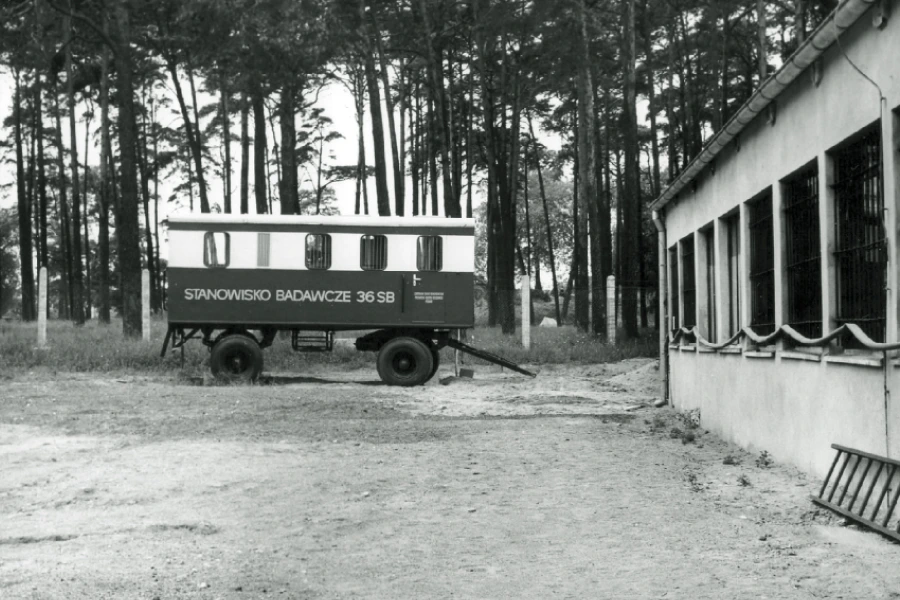
Research and Development Center for Rail Vehicles provided scientific research, design, along with construction, as well as implementation support in the field of diesel and electric locomotives, multiple units (electrical and diesel), various types of passenger and freight cars, including railcars, rail buses, and special vehicles. Since 1971, they have been expanding their research base – a laboratory, a hall with a research station, and prototype workshops have been built.
The center operated actively. It published its own quarterly journal, “Pojazdy Szynowe” (“Rail Vehicles”), had the largest technical library in the industry, and cooperated with research and development centers abroad (especially Comecon countries). It also served as an industry guideline for the Polish Committee for Standardization.
In 1975, it employed over 600 people. Employees published their own wall newspaper and had access to a tennis court and a table tennis room. The development plans were ambitious: by 1980, employment was to increase to 1,000 people.
However, this did not happen. In Poland, Gierek’s “golden decade” was coming to an end, and signs of economic and political crisis were beginning to emerge. Employment in the Center declined, although at the same time, the number of people in scientific positions increased.
However, the design work continued. Diesel locomotives, electrical locomotives, electrical multiple units, railcars. Until the fall of communism, the Center boasted designs for 281 rail vehicles (205 freight cars, 43 passenger cars, baggage cars, mail cars, and heating cars, 27 locomotives and railcars, as well as 6 trams). Almost the entire production of the Polish rolling stock industry was based on design documentation developed at the Poznań Center.
Thanks to its qualified staff and extensive research facilities Research and Development Center for Rail Vehicles was able to conduct research in accordance with the requirements of international standardization organizations. In 1999, it received accreditation from the German railway authority Eisenbahn Bundesamt. This enabled the center to conduct a series of tests, including static and dynamic strength tests on bogie frames and buffers, braking systems, and static strength tests on rail vehicle frames. It held this accreditation until 2007, when EU regulations changed.
On 25 April 2000, the Research and Development Center for Rail Vehicles was transformed into the TABOR Railway Vehicle Institute, becoming the only research institute in Poland that comprehensively conducts work on development, testing, and certification of rail vehicles. Only this unit had full authority to conduct all tests and certifications of rail vehicles.
These were not good times for railways in Poland. Since the political transformation, the number of passengers has been gradually declining. Polish State Railways did not order the new rolling stock. Therefore, the institute focused mainly on rolling stock modernization projects, especially locomotives (diesel locomotives, e.g., the ST44 to ST44-3000 series, and electric locomotives, e.g., the EU07 to EU07A series).
One of the most important projects at that time was the Pesa 33WE – an electric traction unit manufactured for the Warsaw Commuter Railway. The first model hit the tracks in 2012, and these trains continue to transport commuters to the capital to this day.
The TABOR Railway Vehicle Institute also designed the low-floor tram HCP Puma (type 118N), FPS Plus hybrid traction unit purchased by the local government of the Lubusz Voivodeship, and the 111DE dual-drive electric-diesel locomotive, which is intended for passenger and freight transport.
Within the structures of the Łukasiewicz Research Network
After the establishment of Łukasiewicz Research Network (April 1, 2019), the Tabor Railway Vehicle Institute became one of its five institutes in Poznań. At the beginning of 2022, the institutes merged to form Łukasiewcz – Poznań Institute of Technology. The Tabor Railway Vehicle Institute became one of its research centers – the Center of Rail Vehicles.
After two years, Łukasiewicz – PIT changed its structure to a more interdisciplinary one. Two research centers are now continuing the work of the Tabor Railway Vehicle Institute. The Centre for Modern Mobility focuses on the development of rail vehicles – design, automation, and simulation training. In turn, the Centre for Laboratory Research took over the testing of these vehicles – mechanical, electrical, and environmental. The scope of their activities and offer is available here.
Two railway companies were also spun off from the Institute. Since 2023, PIT Industry has taken over tasks related to the production of, for example, equipment for rail braking systems. PIT Certification, on the other hand, has been involved in the certification and inspection of these vehicles since 2025.
Almost everything has evolved since 1945. Both within the institution, which has reformed its name and legal form several times, and in the world at large.
The center on Warszawska Street has survived political transformation, numerous modifications to the railway system, as well as changes in the way of travel. Not only does it keep up with the changes, but it also tries to create them itself, now developing solutions based on artificial intelligence, such as an autonomous tram.
One thing remains unchanged: the passion that drives Polish railways.
You can find more photos here.



 SEE ALL BLOGS