






The success of the Poznań microhub
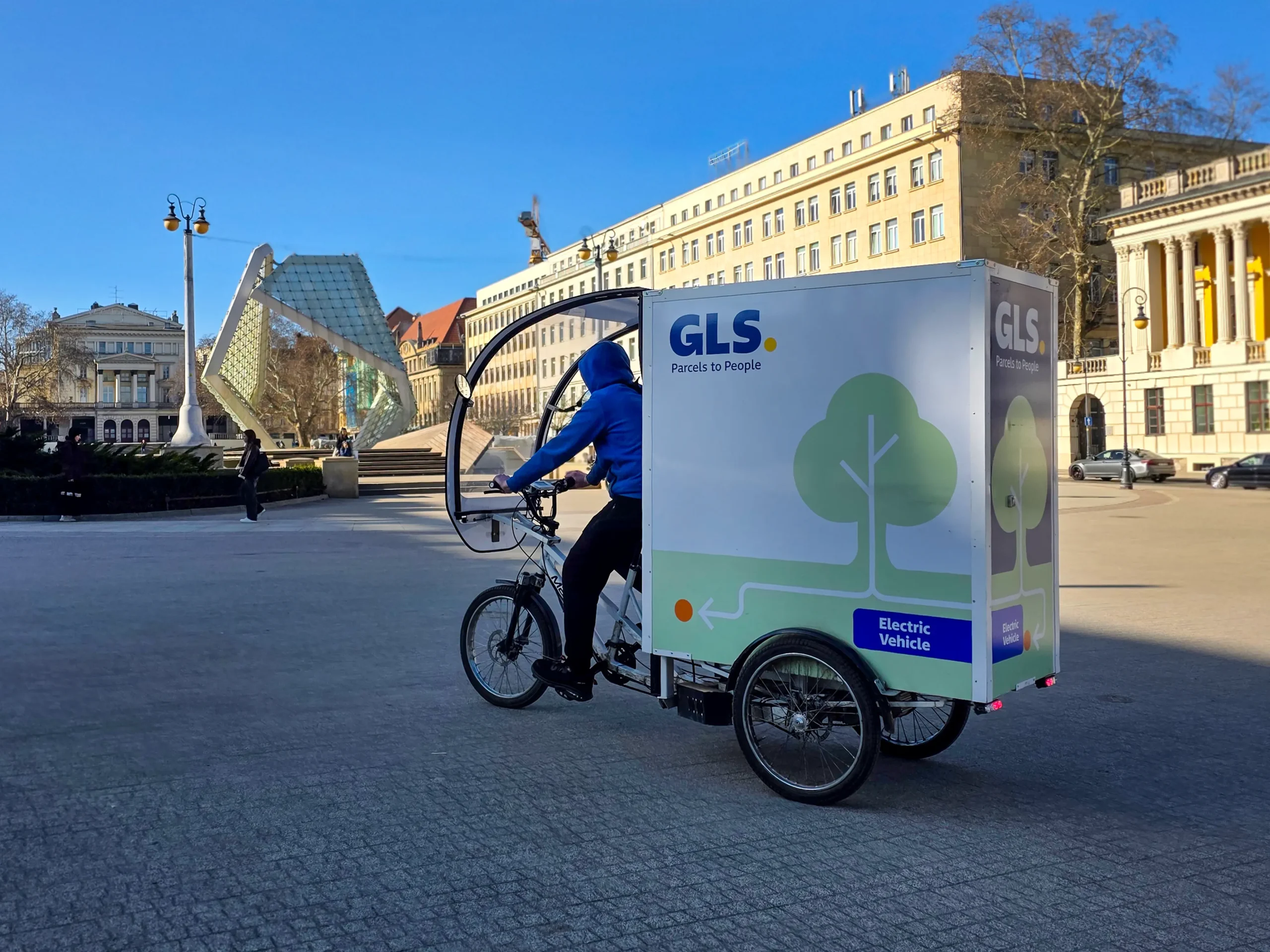
It was intended to be a six-month pilot project. It proved to be such a successful solution that it is still in operation today. The micro-transhipment hub, as it is known, has streamlined the parcel delivery process in the centre of Poznań. Thanks to this initiative and the use of cargo bikes, the carbon footprint of deliveries on the routes analysed has been reduced by almost a third. It is the first solution of its kind in Poland.
The microhub, a small building, was erected on Pułaskiego Street. It was a joint venture between Łukasiewicz – Poznań Institute of Technology, the City of Poznań and GLS Poland. Such a team of partners was essential to gather data from the actual courier delivery process for the research project.
How did the micro-hub work?
Every morning, a van would arrive at the microhub with parcels from the distribution centre. Couriers were waiting for them at the hub; they would transfer the parcels onto electric cargo bikes and set off on their routes. Their area covered the surrounding neighbourhoods. They delivered smaller parcels, whilst larger ones were transported by car.
What data was collected?
Each cargo bike was equipped with a GPS sensor that collected information on its location, the distance travelled, speed and the duration of daily activities (e.g. delivering a parcel from the bike to a collection point). The distance the courier walked to deliver the parcel to the recipient’s door was also estimated.
The data collected was intended to help answer the questions of whether this form of delivery is effective – both economically and in terms of time – and whether it can reduce emissions during the last-mile delivery (i.e. the final stage of the parcel’s journey).
The pilot ran from December 2024 to May 2025. Over the following months, the researchers analysed the data.
Results
Bicycle couriers delivered an average of 31 per cent of all GLS Poland parcels from the analysed region. During the period under review, they delivered almost 19,000 parcels.
The use of cargo bikes reduced the carbon footprint of deliveries in the analysed region by 29.1 per cent (approximately 2 tonnes of eCO2).
It was easier for couriers on bikes to find parking spaces, so they made more stops along the route. As a result, they covered shorter distances on foot than car-based delivery drivers. This is illustrated by an example from one of the days analysed, when a bicycle courier and a car-based courier set out to deliver parcels in the Old Town. There are many one-way streets here and a high density of buildings.
A similar pair set off on the same day for Jeżyce. This district has fewer one-way streets and a lower density of buildings than the Old Town.
The researchers compared the distances the couriers travelled by car and on foot that day:
- In the Old Town, the courier in a car covered longer distances both by car and on foot. He drove 12.42 km and walked 1,423.8 m. The courier on a bicycle covered 11.59 km, but walked only 1,000 m.
- In Jeżyce, the cyclist covered more distance by bike (12.69 km, compared to the driver’s 11.07 km). However, the bicycle courier had a shorter walking route than his motorised colleague (619.8 m and 1,118.7 m respectively).
– The change in delivery method did not affect its efficiency – according to the couriers, most recipients did not even realise that their parcel had been delivered by a cyclist rather than a driver, comments Marta Cudziło from the Łukasiewicz – Poznań Institute of Technology, coordinator of the GRETA project in Poland. – We view the Poznań project as the first step towards the wider implementation of urban micro-hubs in Poland. We are now applying for new projects under which we will expand the hub concept. This includes, for example, sharing it among various logistics operators or adding features such as vehicle charging stations, service points, or facilities for recipients to collect and send parcels, she adds.
The microhub continues to operate
Although the microhub pilot scheme ended in the spring, the solution has been permanently integrated into GLS Poland’s operations and is still used in day-to-day parcel handling.
– GLS Poland has been carrying out deliveries in the centre of Poznań using cargo bikes since 2021 – emphasises Andrzej Wasielewski, Director of Domestic Operations and Infrastructure at GLS Poland. – The microhub has proved to be a functional solution for us in terms of both location and operational organisation – it enables efficient transhipment and temporary storage of parcels, as well as convenient access for couriers. Poznań is an important operational market for us, and good cooperation with the city and local partners has created the conditions for the continued use of the microhub on a commercial basis. The analyses and conclusions prepared by Łukasiewicz – PIT were also a significant asset to the project, providing us with valuable operational data. We are keen to get involved in similar initiatives in other cities as well.
A cleaner city centre
The pilot scheme in Poznań was closely monitored by representatives from other Polish cities, either interested in or already implementing microhubs in their own areas.
“The success of Poznań’s microhub and bicycle deliveries shows the direction logistics in Poznań can take,” says Jacek Jaśkowiak, Mayor of Poznań. “For years, Poznań has been consistently developing its cycling infrastructure and restricting car traffic in the city centre. The environmental aspect is also extremely important. Bicycles do not emit pollutants, so they are the ideal response to these changes. Every such initiative is a step towards a cleaner city centre,” he adds.
The Poznań pilot took place as part of the GRETA research project carried out by Łukasiewicz – Poznań Institute of Technology together with partners from six EU countries. Its aim was to test solutions designed to reduce emissions in urban freight transport.
FIND OUT MORE
9 April 2026
Łukasiewicz – PIT at the ‘Defence and Dual-Use Investment Zone’ conference
24 February 2026
A design for a carriage bogie that can withstand the weight of a tank has been developed in Poznań
17 December 2025
Axially asymmetrical spinning distinguished in the Polish Product of the Future competition

10 December 2025
The future of the forestry and wood sector as seen by experts from around the world. We have just concluded Wood-Science-Economy
 SEE ALL NEWS