





The most interesting European railway lines
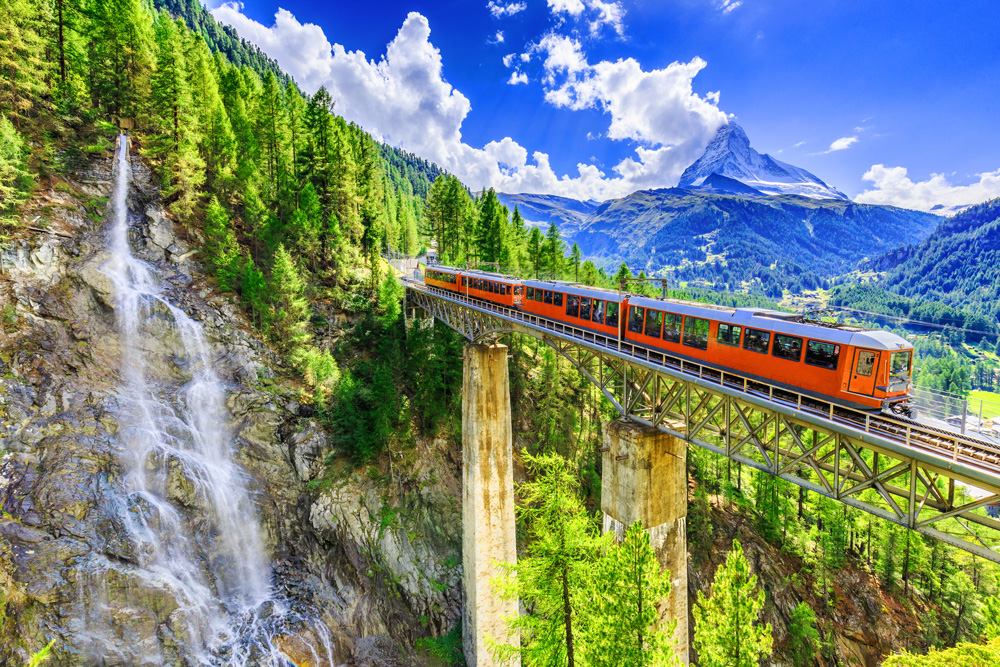
A trip with a view of the Matterhorn, a ride on the steepest cog railway in Europe, or a train from Helsinki to Rovaniemi, the home of Santa Claus and the kingdom of reindeer – these are some of the most interesting ideas for people who love rail travel. Few people know that Switzerland has a train powered by the local sewage system.
Trains in Poland run mainly in lowland areas. Railways reach 7 stations in mountain towns. These are Zakopane, Szklarska Poręba, Kudowa Zdrój, Krynica Zdrój, Wisła, and Zwardoń. According to data from the General Directorate for Environmental Protection, the average altitude above sea level is only 173 meters. As much as 91.3% of the country’s area is lowlands, 5.6% is highlands, and 3.3% is mountains, of which only 0.2% are high mountains, i.e., exceeding 2,000 meters above sea level.
At the other end of the spectrum is Switzerland, for example. As much as 60% of its area is covered by mountains, but it has as many as 5,326 kilometers of railway lines within its borders. Thanks to good transport links and an extensive network of connections, trains are a viable alternative to cars.
Glacier Express and Bernina Express
Despite its location in the heart of the Alps, Switzerland has a well-developed railway network. Trains reach virtually everywhere – not only the largest cities, but also small towns and villages located off the main transport routes. However, the biggest drawback is the high price of each journey.
In this paragraph, we will focus on two panoramic trains: the famous Glacier Express and the lesser-known Bernina Express, which belong to the local carrier – the Rhaetian Railway (Rhätische Bahn) in Graubünden.
The Glacier Express is the slowest express train in the world. It runs between St. Moritz, one of the most famous winter sports resorts, where, among other things, the Ski World Cup competitions are held, and the resort of Zermatt at the foot of the Matterhorn.
The route is 270 kilometers long with an elevation gain of 2,500 meters. Trains cover it in 8 hours, passing through 91 tunnels and over 291 bridges along the way. The highest station on the route is Oberalppass, located 2,033 meters above sea level.
The train consists of panoramic carriages, which offer a perfect view of the surrounding peaks, and a restaurant car. Interestingly, it also runs in winter.
The Bernina Express connects the Swiss city of Chur with Tirano in Italy. The highest point of the route – Ospizio Bernina – is located at an altitude of 2,253 meters above sea level. The route, which is approximately 145 kilometers long, includes 196 bridges and 55 tunnels. Panoramic carriages also operate here.
Steep slopes and sewage
We remain in Switzerland. The Pilatus Railway is the steepest cog railway* in Europe. It has a gradient of 48 degrees. It runs between Alpnachstad and Pilatus from May to November. The train covers the distance of 4,618 meters in about half an hour.
*(According to transportszynowy.pl) A rack railway is a railway with an additional rack rail located in the middle of the track, which is engaged by the cogwheels and brakes of the rolling stock. They are used on lines with steep gradients, where classic traction, i.e., the adhesion of the wheel to the rail, is insufficient to overcome the incline.
The line was officially opened on June 4, 1889, and electrified in 1937. As many as 800 workers were involved in its construction, which took 400 days.
There are several other tourist railways in Switzerland. Most often, these lines operate between hard-to-reach high-mountain resorts. They only operate in late spring and summer, when the weather is more favorable. With some carriers, a tour of local attractions is also included in the ticket price.
Have you ever heard of a railway powered by sewage?
It has been operating in Fribourg, a city located at the junction of two linguistic regions – French and German – since 1899. It is the only gravity-powered railway preserved in Switzerland. It connects the city center with Basse Ville, or the lower town, and the journey takes 2 minutes.
Due to its unusual propulsion system – connected to the local sewage system instead of being powered by “clean” water – it is a tourist attraction in the region. However, some travelers complain about the noticeable smell of sewage, which detracts from the enjoyment of the trip.
Balkan Express. Belgrade-Bar
This route is something special for lovers of the Balkans, beautiful views, and railways.
The line was built in the 1970s. Urban legend has it that it was not built by specially invited experts from France and Switzerland, but by Yugoslav engineers.
The train starts in Belgrade, Serbia. Passing through Lajkovac, Valjevo, Požega, Užice, Priboj, Bijelo Polje, Kolašin, and Podgorica (the capital of Montenegro), the train reaches Bar, a picturesque resort on the Adriatic Sea. The route is 476 kilometers long, of which almost 293 kilometers run through Serbia and 175 kilometers through Montenegro. The train also enters Bosnia and Herzegovina for 8 kilometers, but you should not expect passport control by Bosnian customs officers.
This line is a masterpiece and a great feat of railway engineering. According to the Stacja Bałkany blog, its route passes through 254 tunnels with a total length of 114 kilometers and 435 bridges and viaducts. The train must cross, among other things, the Dinaric Alps and Lake Skadar, the largest lake in the Balkans.
The railway route runs across the highest railway bridge in the world, measuring 499 m in length and 200 m in height, which crosses the Mala Rijeka river canyon.
Currently, the journey takes 12 hours. It is worth noting that it used to take only 7 hours. However, the entire infrastructure around the Belgrade-Bar railway line has aged since the time of Marshal Tito* and now there are local speed restrictions.
* Jozef Broz Tito was first the founder and then the leader of the Socialist Federal Republic of Yugoslavia from 1945 until his death in 1980. During World War II, he was a member of the communist guerrilla movement. As leader, he had his own private, exclusive train called the “Blue Train,” which currently runs from Belgrade to the coast of Montenegro. The cost of such a trip is around PLN 6,000.
Journey to the Arctic Circle
In Finland and Norway, we can reach the Arctic Circle by train. Norway covers an area of 385,207 km2, but its railway network is poorly developed. Trains only run between the largest cities.
However, one railway line reaches the Arctic Circle and ends in Bodø. From the Norwegian capital, Oslo, you can get there with one change in Trondheim. Another option for reaching the distant fjords is to travel from Stockholm, the capital of Sweden, to Narvik, which is located 300 kilometers north of Bodø.
In Finland, there is a night train from Helsinki to Rovaniemi, the home of Santa Claus and the kingdom of reindeer. The train covers 830 kilometers in 11 hours, and travelers can choose from a range of accommodation options, including couchettes.
Did you know that there are no trains in Iceland? There are plans to build a railway line connecting the capital Reykjavik with the international airport in Keflavik.
Record holder
It is worth mentioning one interesting fact from the Apennine Peninsula, reported by the website of the Italian newspaper Il Foglio.
How much time do you spend each day commuting to and from work? 29-year-old Giuseppina Giuliano is a real record holder in this respect. She lives in Naples but works as a janitor at a high school… in Milan.
In the chaos of school bureaucracy, the Italian woman received a job offer in the capital of Lombardy some time ago and decided to accept it. After adding up all the costs, she calculated that renting an apartment or a room would consume half of her salary—Giuseppina earns €1,165 per month, which is below the national average. That is why she decided to commute to work… by high-speed train, because a monthly ticket costs less than rent.
The Italian gets up at 3:30 a.m. The Italo private company train leaves Napoli Centrale station at 5:00 a.m. and arrives in Milan after 5 hours and covering over 800 kilometers. She works from 10:30 a.m. to 5:00 p.m. Then she returns home, covering the same distance, only in the opposite direction. This is an extreme case.
Krakow-Zakopane
Our journey through the most extreme railway lines in Europe will end in Poland. Although the two cities are only 100 kilometers apart in a straight line, the route between Krakow and Zakopane is a torment for tourists.
Traveling by car or bus is not comfortable. The entire route can be covered in 2 hours during less touristy periods of the year, but during peak season, you should add several dozen minutes to the travel time.
Due to the terrain, trains take a different, longer route through Kalwaria Zebrzydowska, Sucha Beskidzka, Maków Podhalański, Chabówka, and Nowy Targ, finally reaching Zakopane. How long does it take? The shortest journeys are made by the IC “Witkacy” (2 hours and 58 minutes) and the IC “Karpaty” (3 hours and 2 minutes).
The Zakopane railway line is also undergoing gradual modernization: reconstruction of tracks, traction network, culverts, level crossings, and traffic control devices, as well as revitalization of railway stations. Polskie Linie Kolejowe S.A. wants the train from Krakow to Zakopane to take 2 hours after completion, which seems optimistic but not entirely unrealistic.
For comparison, after modernization, the 170-180 km section between Poznań and Wrocław can be covered by InterCity train in an average of 1 hour and 40 minutes.
FIND OUT MORE
8 February 2023
Ultra-durable materials. Will Polish scientists conquer space?

15 February 2023
Why do we eat donuts on Thursday? And how do regions shape our culinary taste?

12 January 2023
Do you travel by train? These apps are worth having on your smartphone

5 January 2023
When and what to do with the Christmas tree after the holidays?
 SEE ALL BLOGS