






Reverse logistics, or the green alternative for the world
According to data from the European Environment Agency, in 2019, the entire transportation sector was responsible for approximately 25% of carbon dioxide emissions into the environment in the European Union. As much as 71.4% was produced by road transport, 14% by water transport (maritime and inland), and 13.4% by civil aviation. The lowest-emission mode of transport is rail, which accounts for only 0.4% of emissions.
Most interestingly, EEA reports that transport is the only significant sector of the economy where greenhouse gas emissions have increased over the last three decades, between 1990 and 2019. This process is mainly driven by two factors: globalization and growing consumerism. It is thanks to the well-developed transport network that we have access to a wide variety of products all over the world at our fingertips. On the other hand, societies, especially Western ones, are spending more and more, boosting national economies.
Reverse logistics in e-commerce
A growing number of courier industries are investing in electric delivery trucks. In Poland, practically every major e-commerce brand has such units, e.g., DHL, DPD, GLS, and InPost. They can be found primarily in the centers of the largest cities, including Warsaw, Poznań, Kraków, Szczecin, Olsztyn, and Gdańsk.
In 2021, DHL Poland expanded its fleet with 150 MAN eTGE electric vehicles. The battery of the MAN design allows for a range of approximately 110 kilometers on a full charge. This is not a staggering number, but it is sufficient for easy operation in large cities, close to distribution centers equipped with charges.
Last year, GLS Poland decided to take a similar step. According to Rzeczpospolita, they chose the Ford e-Transit. The range of cars is significantly greater than that of the competing model, at almost 260 kilometers, and charging takes only 30 minutes. InPost boasts a fleet of over 300 vehicles, consisting of Nissan e-NV200s and Mercedes eSprinters, as reported by the Rynek Infrastruktury. Whereas DPD has 300 electric MAN and Mercedes vehicles in its fleet.
This trend clearly shows that the largest companies in the mail order industry are not afraid to invest in modern technologies, especially those that are low-carbon. The use of electric delivery trucks between shipping hubs and for distributing shipments in smaller towns and rural areas remains an issue to be resolved. Couriers then must cover a significantly greater number of kilometers, and the availability of charging stations is usually much lower.
Are cargo bikes the solution for deliveries in city centers?
A few years ago, the reality of mail order was revolutionized by InPost parcel lockers, which appeared on every corner. The Polish logistics operator showed how innovation can surpass the competition.
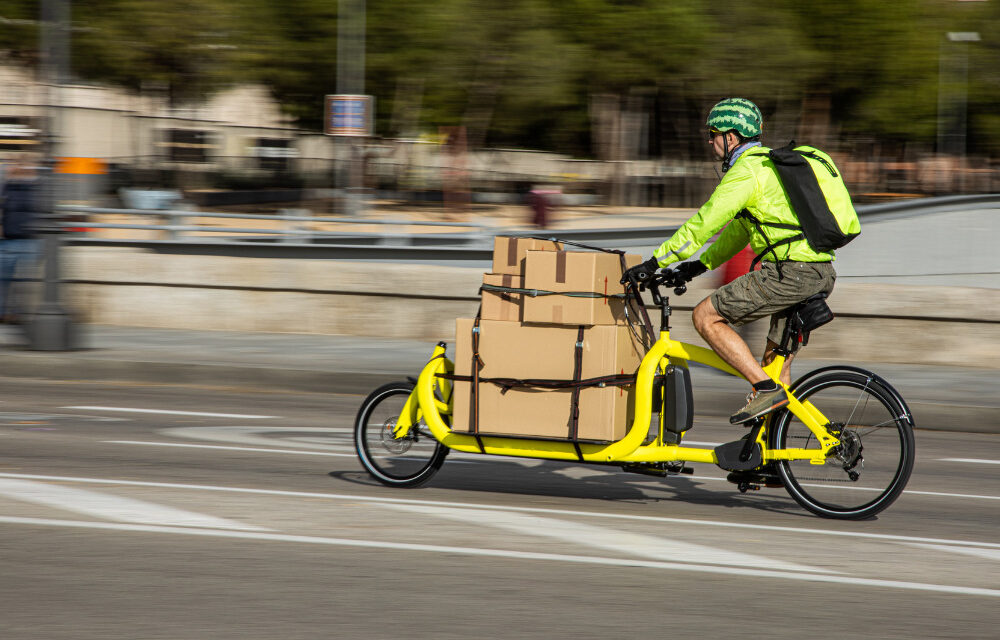
E-commerce still isn’t slowing down, and proposes another solution to improve the supply network, this time in large metropolitan centers. Where delivery trucks are not allowed due to CO2 emission restrictions, electric cargo bikes are the perfect solution. Thanks to their size, these two-wheelers can go practically “anywhere” and deliver orders quickly. Additionally, couriers don’t have to worry about traffic, a limited number of parking places, and other road obstacles.
In the pages of “Logistyka” magazine, Paweł Rataja, founder of Urvis.Bike, Poland’s first bicycle delivery startup. This is how he describes the capabilities of this type of bike: “In tight, congested spaces, cargo bikes can deliver parcels 60 percent faster than a delivery van. These are the specific data based on research by the Possible organization”.
The owner of Urvis.Bike took a similar stance on the podcast “Obok Logistyki”, where he explained in more detail the phenomenon and growing trend of using cargo bikes in metropolitan areas.
The trend of reducing CO2 emissions in larger city centers will continue to intensify. Krakow city councilors have already taken the first effective initiative. From July 1, 2024, a Clean Transport Zone will come into operation in the capital of Lesser Poland, initially covering only the oldest cars, but eventually expanding to include newer and newer models. Officials in Warsaw are also working on a similar resolution. The question remains: Will large companies want to invest in this model of parcel delivery?
You can find more information about bicycle solutions in logistics in articles featuring expert commentary by Arkadiusz Kawa, Director of the Institute, published in Rzeczpospolita and Wiadomości Handlowe.
Reusable packages
Another revolutionary idea is e-Pack, a smart package developed by scientists from Łukasiewicz – PIT with the support of Łukasiewicz – Institute of Microelectronics and Photonics from Warsaw and Łukasiewicz – Łódź Institute of Technology.
To create the smart package, researchers used durable, reusable materials. According to preliminary measurements, the e-package’s life is expected to last at least 5 years, which will be further supported by a system of sensors that records damage. This is a technological and ecological solution designed to reduce the growing problem of the carbon footprint in e-commerce. This situation is not only caused by transport, but also by packaging, which is usually made of paper.
Among others, “Business Insider” has already written about e-Pack. The first companies are already expressing interest in the project, and one of Łukasiewicz – PIT’s partners is testing a prototype of the e-packaging, as well as a return slot and an application supporting the operation of the device in its own warehouse.
Reverse Logistics at sea
Maritime logistics is one of the most important branches of the global economy, serving as the glue that holds international trade together. Connects individual elements of the global production and supply chain. According to the official government website of the former Ministry of Marine Economy and Inland Navigation, the maritime transport sector accounts for nearly 90% of the volume (quantity) and 70% of the value of international trade, i.e., approximately $16 trillion in 2019.
People have long transported goods by sea, e.g., from America or India to Europe during colonial times. The transport branch experienced a particular boom in the 1990s, when globalization processes accelerated, and the Chinese economy opened to trade with capitalist countries. The economic crisis from 2008, or the global coronavirus pandemic, which has particularly affected China, has temporarily caused a slight decline, but not changed the trends.
When, in 2021, one of the ships, the Panama-flagged container ship Ever Given, ran aground and blocked the Suez Canal in both directions for six days, we witnessed the immediate paralysis of goods transport and, consequently, the global economy. Dozens of other vessels lined up behind it, unable to pass the 400-meter bulk carrier and forced to wait for it to be removed.
According to the data from the website „marinetraffic.com”, there are currently 190,000 different vessels sailing the seas and oceans. Fuel, emulsions, oils, lubricants, exhaust fumes, sewage – all these substances can end up in the water and have a negative impact on the natural environment.
Where is the place for ecology?
Although most ships sail under the flag of a country unrelated to the ship owner to take advantage of liberal tax, international agreements and treaties apply in international waters. In accordance with the provisions of the Helsinki Convention, in the Baltic Sea, which is a closed body of water, marine vessels are completely prohibited from discharging any waste into the water. Waste is only collected in ports.
Eco-trends have also reached contrition industry. According to the „portalmorski.pl” website, 34 of the new ship orders worldwide are for vessels powered by alternative fuels, with engines adapted to burn LNG, or liquefied natural gas, remaining the leading option. The global procurement market continues to show an upward trend. Poland is a significant manufacturer of LNG-powered ships, mainly small ferries.
The non-ecological dimension of maritime transport
Every year, hundreds or even thousands of new ships are put into service. Whereas some of the older ones are being withdrawn from further use or are waiting in anchorage (a place where ships moor) for “better times”.
When it comes to scrapping vessels, international institutions and public benefit organizations have room to take extensive action and, consequently, introduce legal regulations. Instead of shipowners transferring rusty ships to countries in the Global South, they could take greater responsibility. Otherwise, the problem will worsen, and as a result, garbage and various types of waste, such as grease, oil, and fuel, will end up in the oceans.
According to a DNV report based on data from Lloyd’s List Intelligence, safety at sea is improving despite the increased traffic. The number of ships lost in various incidents is gradually decreasing. The number of victims of maritime accidents is also declining (from 123 in 2012 to 58 in 2020). Designers are building increasingly larger vessels equipped with modern technologies, which in turn increases the competence of the crew.
However, ship scrapping has remained stuck in the previous era. Mainly due to complex legal regulations in Western countries concerning occupational safety and environmental protection, in the 1980s, scrapyards moved from Asia or Africa. What had previously been a profitable business became unviable for most Western entrepreneurs due to the small profits that could be made from the sale of recovered materials compared to the rest of the cost.
At this moment, most large ships are being scrapped in three scrapyards – Alang in India, Chittagong in Bangladesh, and Gadani in Pakistan. The term “shipyard” is a misnomer. These are simply wide straps of waterfront where ships that have been traveling at high speed come to a halt. The units are brought ashore and then pulled deeper into the beach using ropes.
The dismantling of a single ship using simple tools takes from several to over dozens of weeks. The more valuable the materials are, the faster it is dismantled. According to Amnesty International, employees cannot count on good working conditions. They are merely cheap labor exploited by Western shipowners. Employees work there without protective clothing and other safety measures, even though they may be exposed to harmful chemicals. For sacrificing their lives and health every day, they receive barely a few dollars in payment.




 SEE ALL BLOGS