






Modern technologies on the battlefield: drones, robots and future medicine
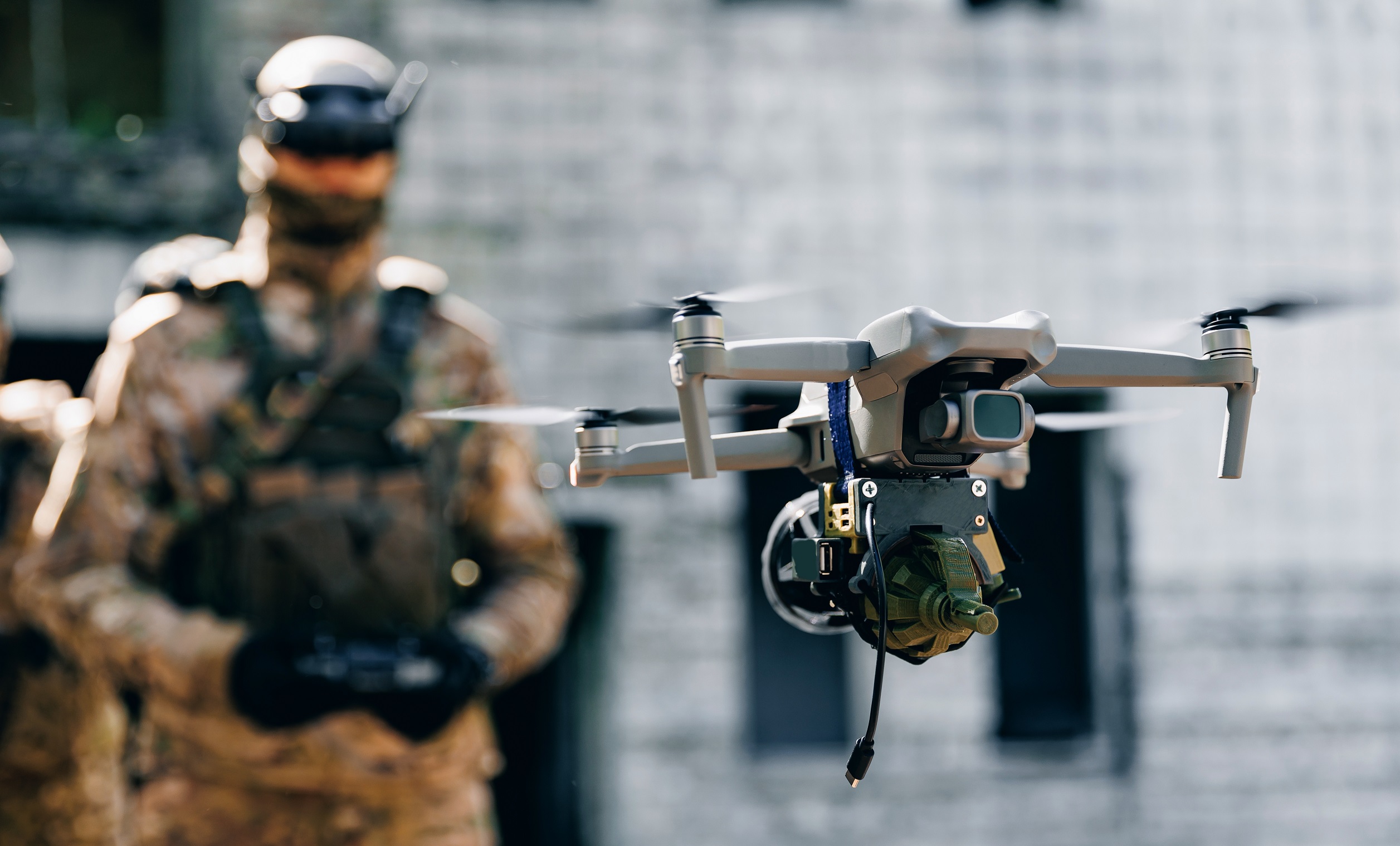
From autonomous drones to transport robots and advanced battlefield medicine, these innovations are redefining the way military operations are conducted and increasing the safety of soldiers. They make armed conflicts look completely different from what we know from history lessons, even the most recent ones.
Armed conflicts are a powerful driver of technological development. Many of these technologies are later applied in civilian life. One example is GPS technology, which was developed for military purposes and is now used on a daily basis, for example in popular map applications.
Experts agree that the rapid development of technology has significantly influenced the modern battlefield. It is completely different from the fronts of 20th-century wars. Here are a few examples of how today’s theatre of war has changed.
Drones, unmanned aerial vehicles and remote soldiers
One of the symbols of the war in Ukraine are drones. They are effective for many reasons. Firstly, they fly too low to be targeted by military aircraft, but high enough to make life difficult for infantry soldiers. There are many types of drones, depending on their purpose. Secondly, the operator of such a drone is usually in a safe position and can avoid danger, and some of them do not need an operator at all. Thirdly, they are fast and cheap to produce.
But what is meant by the term ‘drone’? Practically anything that flies and is remotely controlled: from simple photographic drones available in supermarkets for a small amount of money, to drones for strictly military purposes, manufactured for the needs of the army.
What tasks do drones perform? The smaller ones, with a short range, are used by reconnaissance groups and provide detailed information about enemy movements, terrain topography and other information needed by, for example, a reconnaissance unit. They significantly affect its effectiveness and the reliability of the information obtained. However, this does not eliminate the presence of soldiers in the field.
In addition to standard observation systems such as thermal imaging and night vision, drones can be equipped with advanced electronic reconnaissance tools (SIGINT/ELINT) and signal and communication analysis systems. In practice, this means that solutions crucial for tactical operations can be integrated into a small mobile platform. Combined with artificial intelligence and machine learning algorithms, this significantly increases the effectiveness of reconnaissance and operational support.
Land-based robotic platforms are playing an increasingly important role. Thanks to their modular design, they can perform a wide range of functions, from logistics and reconnaissance to combat. Examples include the four-legged robots developed by Boston Dynamics, as well as their counterparts developed by Asian manufacturers.
These types of platforms can be equipped with communication systems, electronic warfare modules or weapons, depending on operational needs. At the same time, fully autonomous miniature reconnaissance sensors, such as Dust systems, are being developed. Their task is to collect data on enemy activity discreetly over long periods of time and transmit it to analytical systems.
The scale of the coming changes is well reflected in the forecast of retired General Mark Milley, who points out that within 10-15 years, every third soldier in the US Army will be a robot.
Another significant change is the wider use of unmanned underwater vehicles. Such a vehicle has no crew to complain about the long-term effects of being in conditions of variable pressure. It is smaller in size, can resemble a fish, and can operate for many hours with minimal fuel consumption. Examples of this are the American-Australian unmanned vessels Ghost Shark and Manta Ray.
Where doctors cannot help, machines will
As military experts emphasise, the lives of soldiers are becoming a strategic resource. It is therefore essential that medical care keeps pace with technological developments and the changing conditions of the modern battlefield. We probably have an image in our minds of a field medic who, risking his life, collects and treats wounded colleagues during battle or in a hastily built field hospital. It is a popular myth that the main cause of injuries among soldiers is gunshot wounds. Today, it is more often all kinds of wounds caused by explosions. These range from minor burns and shrapnel in the body to severe bodily injury. They require faster and more comprehensive medical intervention than was previously the case.
Technology has responded to these needs. For example, there is an automatic platform for transporting the wounded. It looks like a stretcher on tank tracks. Once the patient is placed on it, a preliminary diagnosis can be made during transport (it is equipped with monitors and sensors), medication can be administered, or a direct connection can be made to a medical facility away from the conflict zone. When the patient arrives at the hospital, the attending physician has complete information about their condition and is ready to provide detailed assistance.
There are several similar solutions, and they can reach more difficult terrain faster than a traditional ambulance. MEDI-MULE, a walking machine, has a range of up to 5 km and can fully stabilise the vital signs of the injured person.
In addition, thanks to AR (augmented reality) technology, communication and medical teams can be managed more efficiently using holographic interfaces. AI, in turn, helps diagnose and predict possible complications. General Grzegorz Gielerak, MD, PhD, director of the Military Medical Institute – National Research Institute, cites data on the Defence24.pl portal. He writes that the implementation of these technologies has reduced the time required for medical evacuation qualification by 37 per cent and the time required for clinical decision-making by 40 per cent. Pilot implementations of modern technologies in NATO units show a 63 per cent increase in the effectiveness of field rescue compared to traditional methods.
What about missiles?
Guns, cannons, barrels, missiles, and armor. Despite advanced technologies, these are still integral elements of armed combat. This does not mean that we cannot talk about development and technological progress in the field of missiles, for example. Among the multitude of types and calibers, it is worth paying attention to shaped charges.
A conventional projectile uses its kinetic energy to penetrate the target. The longer it flies, the more energy it loses. An armor-piercing projectile works differently. The energy is generated only after the projectile comes into contact with the target. This is due to its special design, which necessarily includes an armor-piercing insert.
Today, after years of testing, this insert is cone-shaped. The material from which it is made and the quality of its manufacture are also important.
Researchers from Łukasiewicz – PIT have managed to create a perfectly smooth insert with a uniform structure that provides the highest anti-armor effectiveness. This insert was presented at the International Defense Industry Exhibition in Kielce in September 2025.




 SEE ALL BLOGS